Artemisia Gentileschi Painted the Beheading Twice, and the Second Was Worse
Two canvases, one subject: why the Naples version hits harder, and what the comparison with Caravaggio actually shows
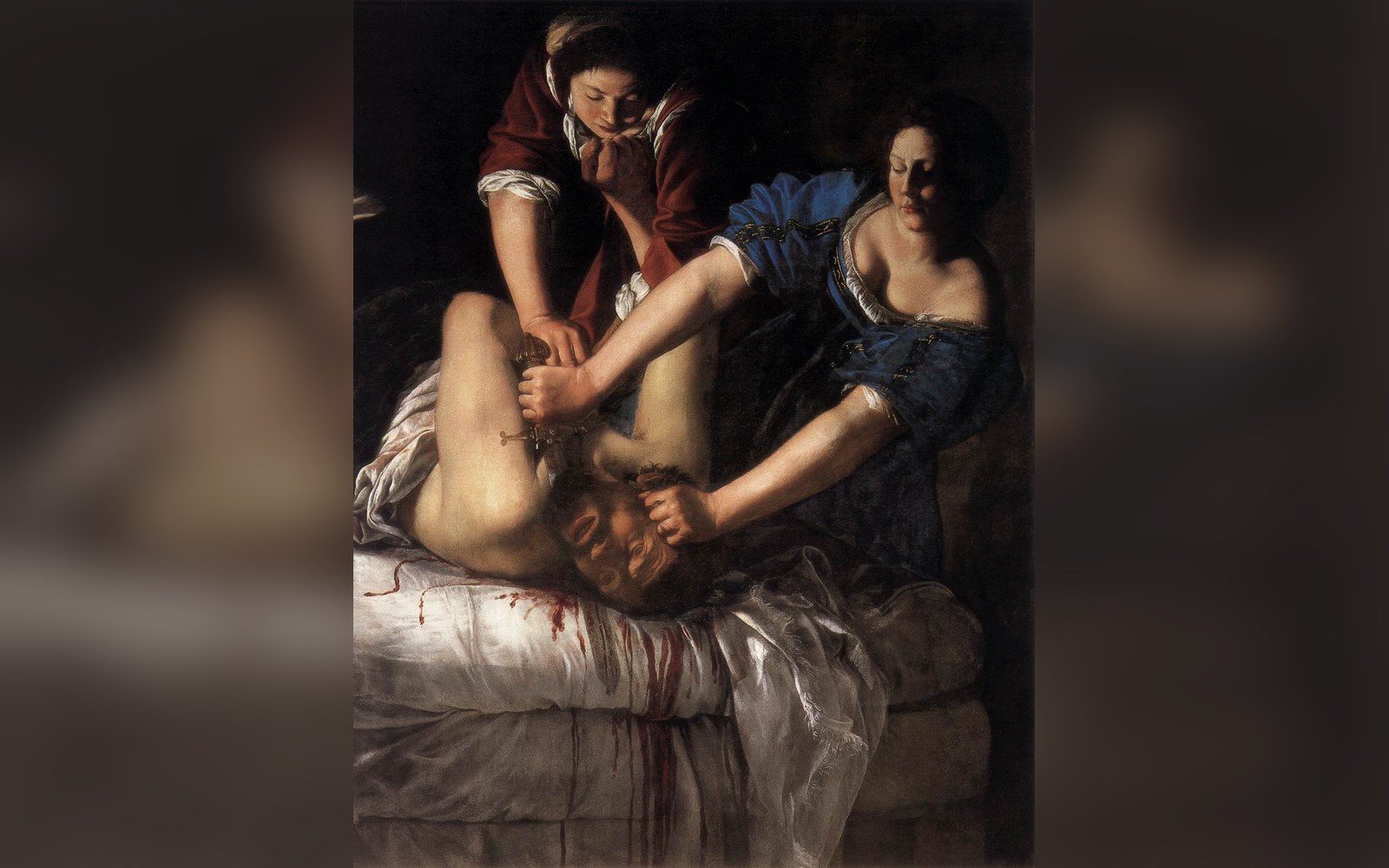
The Naples canvas: the arms are doing work, which is what separates it from Caravaggio’s.
Photo: Artemisia Gentileschi - Judith Beheading Holofernes - WGA8563 · Wikimedia CommonsThe First Version: Work, Not Allegory
The Judith Slaying Holofernes in the Museo di Capodimonte, Naples dates to roughly 1614–20 and is the painting that still stops people in the room. Two women bear down on a man across a bed. Judith grips Holofernes by the hair with her left hand and drives a sword through his neck with her right; her maidservant Abra pins his torso with both arms. Blood runs in sheets. The figures lean into the effort with the full weight of their bodies — tendons taut, sleeves rolled, faces set in the particular blankness of hard physical work rather than the theatrical grimace that lesser painters gave the scene. The canvas is lit by a single source from the upper left, in the manner Caravaggio had established, and the Caravaggesque debt is real and not disguised. But the mechanics of what the painting depicts are different: Caravaggio's Judith, in the version now in the Galleria Nazionale d'Arte Antica in Rome, holds the sword at arm's length and turns her face slightly away, as if reluctant to be too close. Gentileschi's figures are in the thing. There is no recoil.
The documented facts of Gentileschi's biography are relevant here without requiring speculation. In 1612 she testified in a Roman court in the rape trial of Agostino Tassi, her father's collaborator. The trial record survives. She was cross-examined over multiple sessions and subjected to torture by thumbscrew to test her credibility — standard Roman legal procedure, and standard in its cruelty. She was seventeen at the time of the assault in 1611; she was eighteen at the trial. The Naples Judith was painted sometime in the years immediately following. Critics who refuse to connect the canvas to those events are performing a kind of neutrality that is itself a choice; critics who reduce the painting to autobiography are doing it a different disservice. What can be said without invention: Gentileschi had more reason than most of her contemporaries to understand violence as something that happens in a room, to a body, by another person's hand — and her rendering of it reads differently for that understanding.
The Second Version: What Diminished
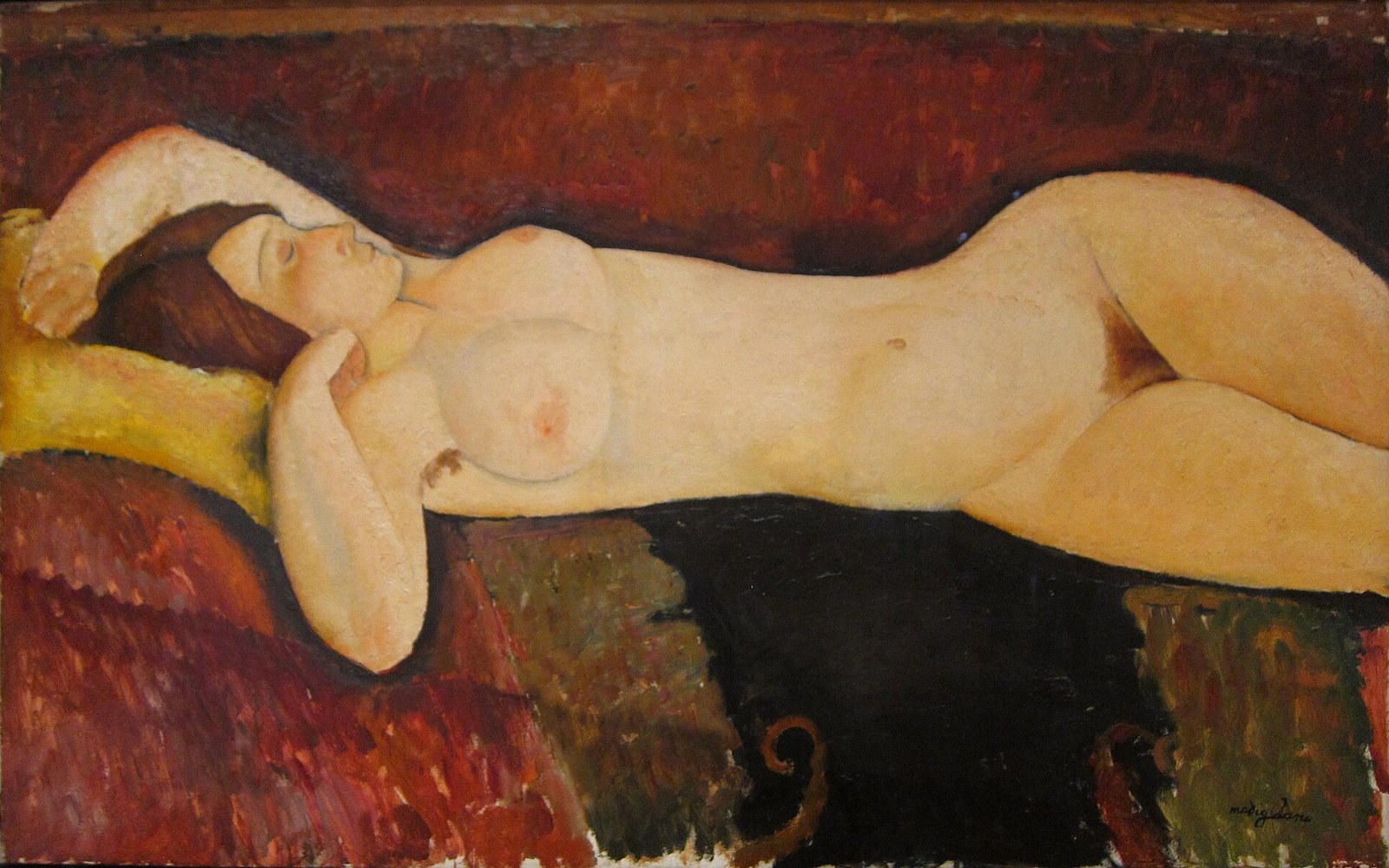
One of the nudes hung facing the rue Taitbout — the reason the police came.
Photo: Amedeo Modigliani - Le Grand Nu · Wikimedia CommonsThe Uffizi Judith, held in Florence ↗ and dated to around 1620, is the painting most reproductions use, possibly because it is more composed. The figures are better lit, the drapery more elaborate, the spatial arrangement tidier. It is also, by almost any measure of visceral authority, the lesser work. The two women have separated slightly; the dynamism of the earlier composition — that locked, three-body struggle — has loosened into something more posed. Abra stands back rather than throwing her weight in. Judith's expression has moved from blank purpose toward something that reads as emotion, which is a step toward the allegory the Naples version had refused. The handling is more finished, the surfaces more easily beautiful.
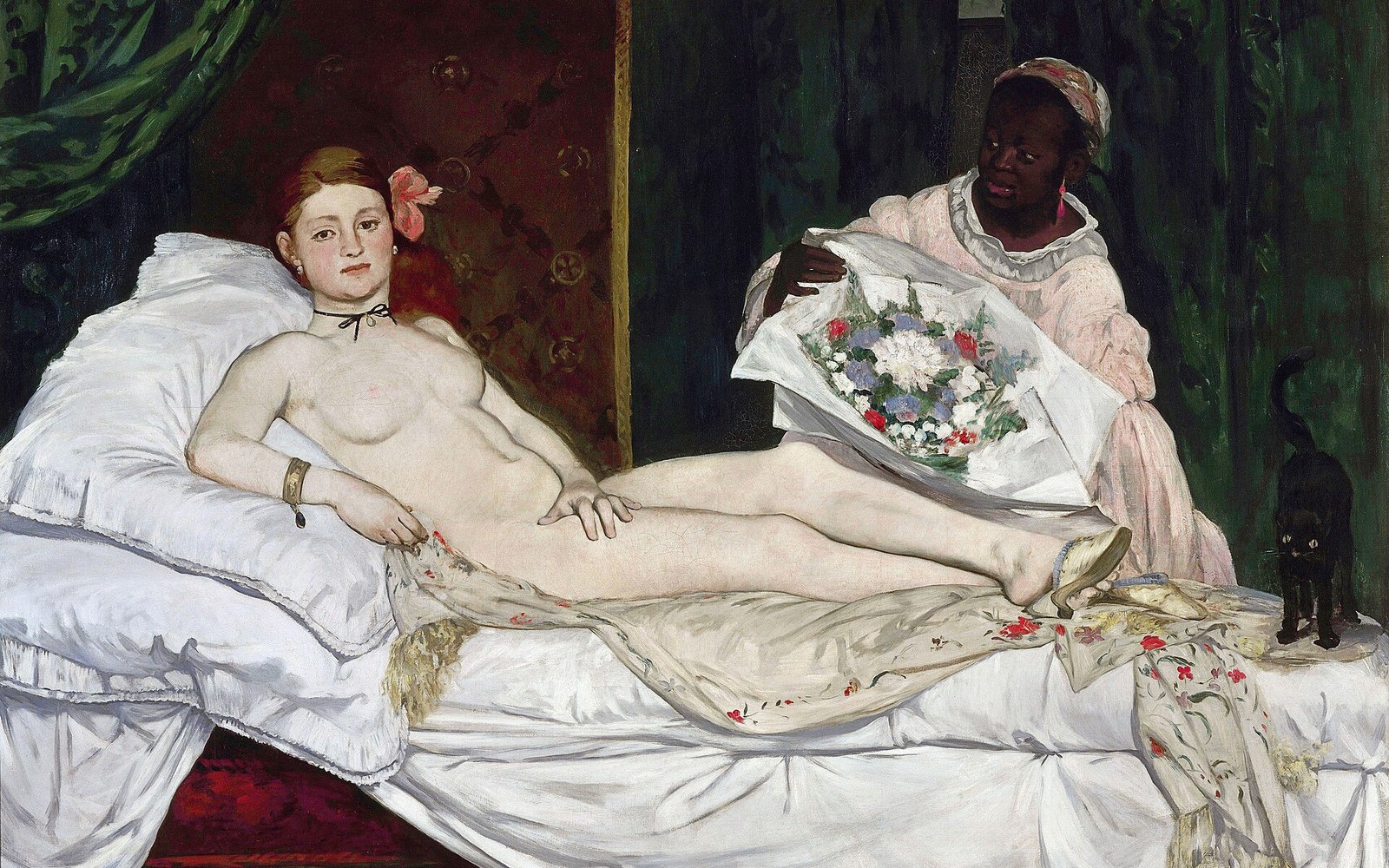
Olympia on the wall at the Musée d’Orsay, where the picture has hung since 1986.
Photo: Edouard Manet - Olympia - Google Art ProjectFXD · Wikimedia CommonsThis is a pattern worth naming. Gentileschi painted the subject several more times across her career — in versions of Judith with her Maidservant that survive in Palazzo Pitti and in Detroit — but the Naples canvas remains the painting against which the others lose. What the later Uffizi picture shows is not a failure of skill but a kind of settling into the expected mode: the heroine properly lit, properly differentiated from her servant, properly displaying the gravity of what she has done. The Naples version had shown the doing, not the gravity afterward.
Caravaggio's Judith, painted around 1598–99, is a superb picture about hesitation. Gentileschi's Naples Judith is a superb picture about no hesitation at all. That is the distance between them — not technical, not even temperamental in any reducible sense, but a difference in what each painter decided the story was actually about. The Uffizi canvas moves back toward Caravaggio's version of events. That retreat is precisely what makes it the lesser painting.