Munsell Gave Flesh a Number, and Some Painters Found That Useful
A notation system built for schoolchildren became, in the hands of certain figure painters, the most precise map of human skin tone anyone had ever drawn.
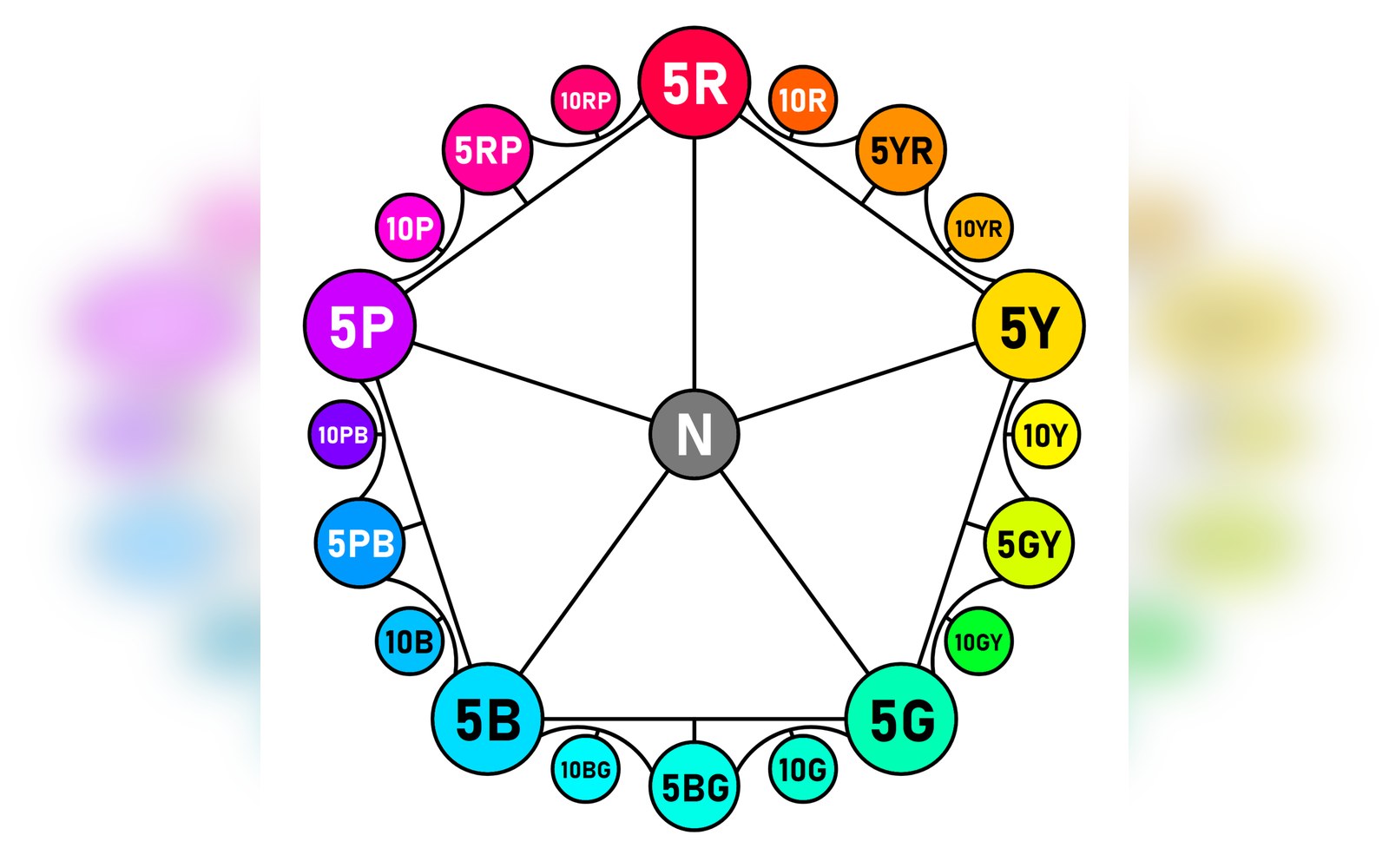
Munsell’s notation laid out as hue circles — the object painters were asked to read flesh against.
Photo: Twenty hues of the Munsell color system at maximum chroma · Wikimedia CommonsHue, Value, Chroma — and Why the Order Matters
Albert Munsell was a painter and art teacher in Boston who found colour wheels philosophically untidy. In 1905 he published A Color Notation, proposing that any colour could be fixed by three independent variables: hue (its position in the spectrum), value (its lightness from black to white on a scale of 0 to 10), and chroma (its saturation, measured outward from a neutral grey axis). The system was not a wheel but a three-dimensional solid — lopsided, irregular, because Munsell's system ↗ acknowledged from the start that human perception is not symmetrical. A yellow at maximum chroma sits much higher in value than a purple at maximum chroma. The sphere that colour theory usually draws is a lie of convenience; Munsell drew the actual shape.
The physical object that resulted from this work is the Munsell Book of Color, a loose-leaf binder of matte and glossy chips, each printed to a measured standard and notated with its coordinates. The American National Standards Institute adopted the Munsell system as a reference framework, and it has since been used to classify everything from soil samples to dental shades. For painters, the relevant chapters are narrow: the chips that run through the red-yellow corridor where most human skin sits, roughly in the hue families Munsell designated 5R through 10YR, with values between 3 and 8 and chromas that rarely exceed 6 in life, however vivid a cheekbone looks in raking light.
That last point is the pedagogically useful one. Skin, observed without assumption, is far lower in chroma than most beginners mix it. The impulse is to add more red, more orange — to push toward what the brain expects flesh to look like. Munsell notation gives a student a number to check that impulse against. The system does not tell anyone what colour to mix; it describes where a colour sits, which is a different and more useful thing.

Lead white on the knife — dense, slow-drying, and the reason so many old grounds still hold. — Lead White: Why the Best Ground Is Also the Most Dangerous.
Photo: Stephen Leonardi / PexelsFrank Reilly and the League

Unprimed linen, still sold by the metre off the same Belgian looms.
Photo: cottonbro studio / PexelsThe figure painter who built the most durable teaching apparatus around Munsell notation was Frank Reilly, who taught at the Art Students League of New York ↗ from the 1940s until his death in 1967. Reilly had trained under Frank Vincent DuMond and absorbed the League's tradition of long, technically deliberate instruction, but he pushed it toward a system more explicit than anything the nineteenth-century academies had codified. He organised his palette by Munsell value steps, charted the dominant hue shifts that occur across a figure as planes turn from light into shadow — the shift toward cooler, lower-chroma mixtures in half-tones being a particular preoccupation — and drilled students in identifying value relationships before touching chroma at all.

Winsor & Newton tin, sable to hand.
Photo: Anna Tarazevich / PexelsThe Reilly method, as it became known, identified skin tones moving through light, half-tone and shadow as a predictable progression through value and hue, not an improvised response to each sitting. It was systematic enough to be transmitted without the master in the room, which is partly why it persisted: former students taught it, wrote notes from it, and organised colour charts around it decades after Reilly's death. The approach divided opinion, as codification always does in painting. Painters who prized the unpredictability of a specific model under specific light found it reductive. Painters who had wasted years matching colours intuitively found it liberating.
The system does not tell anyone what colour to mix; it describes where a colour sits, which is a different and more useful thing.
Neither criticism nor endorsement is the point here. What Munsell provided, and what Reilly appropriated, was a shared vocabulary that made disagreement precise. When a teacher says a half-tone is too high in chroma, and a student can measure that claim against a chip in a binder, the correction is falsifiable. That is rarer in painting instruction than the volume of instruction would suggest.
The Munsell Book of Color remains in print, produced now by X-Rite, the colour-management company that acquired the Munsell brand. A studio painter consulting it today is using a notation stabilised, in its essential structure, since 1905 — which is, in the history of figure painting's engagement with colour theory, quite recent. The problem it addresses, though, is as old as the first attempts to render a living face in pigment: how close to the skin can a number actually get you?