Olympia, and the Fortnight Paris Spent Shouting at a Cat
Manet submitted a nude, a maid, a bouquet, and a small black cat. Critics wrote mostly about the cat.
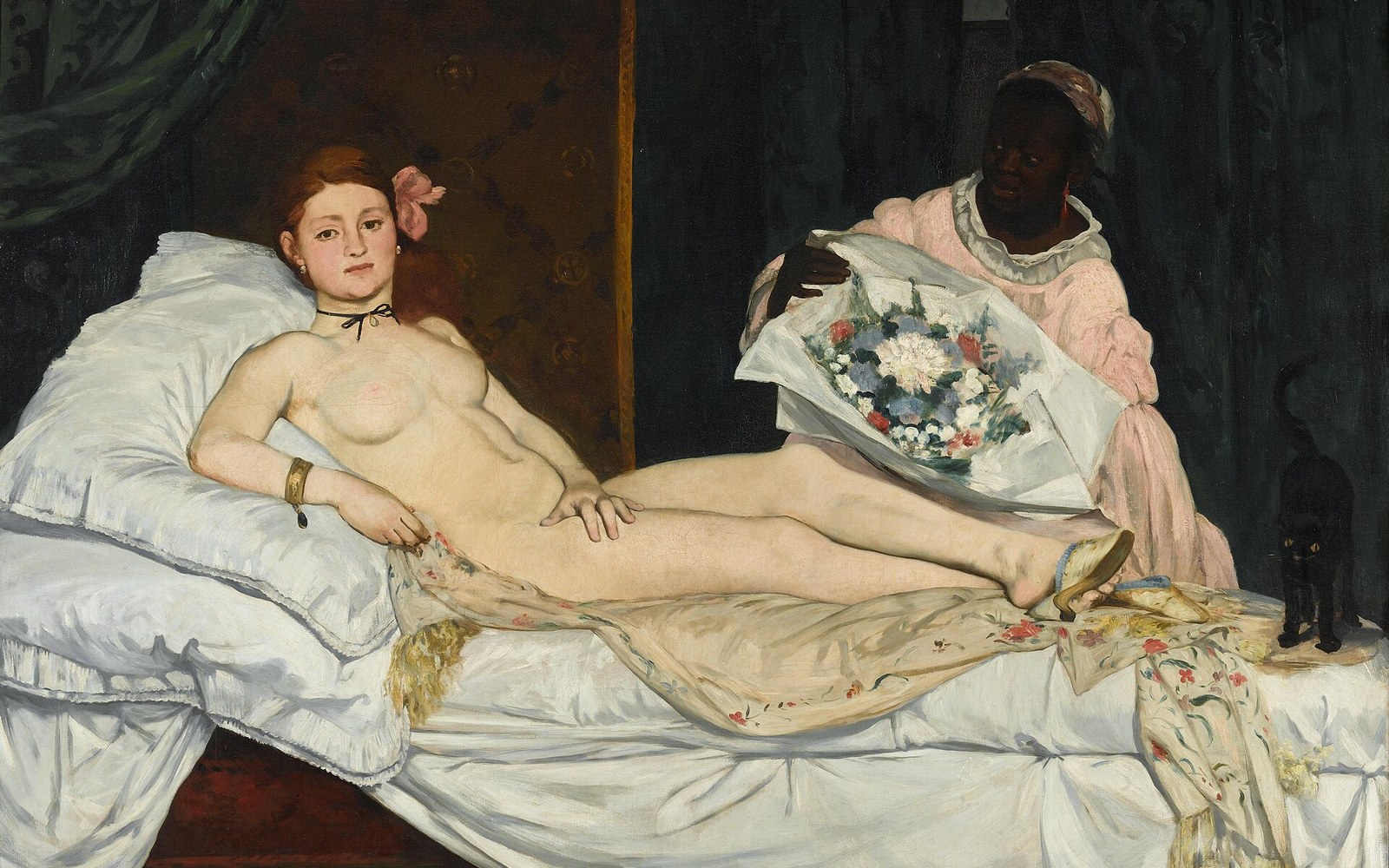
The canvas as the Salon crowd of 1865 met it: 130.5 by 190 centimetres of Parisian studio light, a retained slipper, and a cat holding its end of the gaze.
Photo: Edouard Manet - Olympia - Google Art Project 3 · Wikimedia CommonsWhat the Catalogue Said and What the Canvas Actually Shows
The livret for the 1865 Salon listed the painting simply as Olympia, alongside a couplet by Manet's friend Zacharie Astruc treating the subject as a figure half-born from night. The title was a professional pseudonym common enough among Parisian models that nobody in the Salon crowd would have missed the reference. The catalogue also listed a second Manet — Jesus Insulted by the Soldiers — which drew only mild disapproval and is now far less famous. That pairing was probably deliberate: a sacred subject to steady the room before the figure painting detonated it.
The canvas itself, oil on linen, measures 130.5 by 190 centimetres and hangs today at the Musée d'Orsay in Paris ↗. A woman reclines on a white daybed, her body turned fractionally toward the viewer, one hand pressing flat across her thighs in a gesture that is simultaneously modest and confrontational. She wears a satin mule on one foot, a narrow black ribbon at her throat, a bracelet, and a flower tucked behind her ear — clothing, in other words, deliberately retained to make the rest of her nakedness more pointed. Behind her, a black servant holds a large paper-wrapped bouquet, presumably just delivered. At the foot of the bed, a small black cat stands with its back arched, tail raised. The woman looks directly out at the viewer. The cat does too.
Titian Restaged in a Paris Studio
Manet had been studying Titian's Venus of Urbino for years — he made a painted copy during a visit to Florence in 1853 — and Olympia is a deliberate citation. The horizontal figure, the bent arm resting at the hip, the divided background with a standing figure in the darker half: the structural rhymes are precise. Where Titian placed a sleeping dog at Venus's feet, Manet placed a waking cat. Where Titian's attendants are absorbed in a cassone, searching for cloth, Manet's figure turns forward with a bouquet whose origin the viewer is invited to supply.
The comparison Manet built into his painting was not hidden — critics identified it immediately, which was part of the problem. To set Olympia against the Venus of Urbino was to insist on a continuity between the Venetian tradition and a contemporary Parisian interior, with a model who was, evidently, a specific modern woman rather than an allegorical principle. The goddess had become a professional, the domestic space a working one, and the donor's gaze — the implicit gaze of the painting's original patron — had become the gaze of whoever happened to be standing in the Salon.
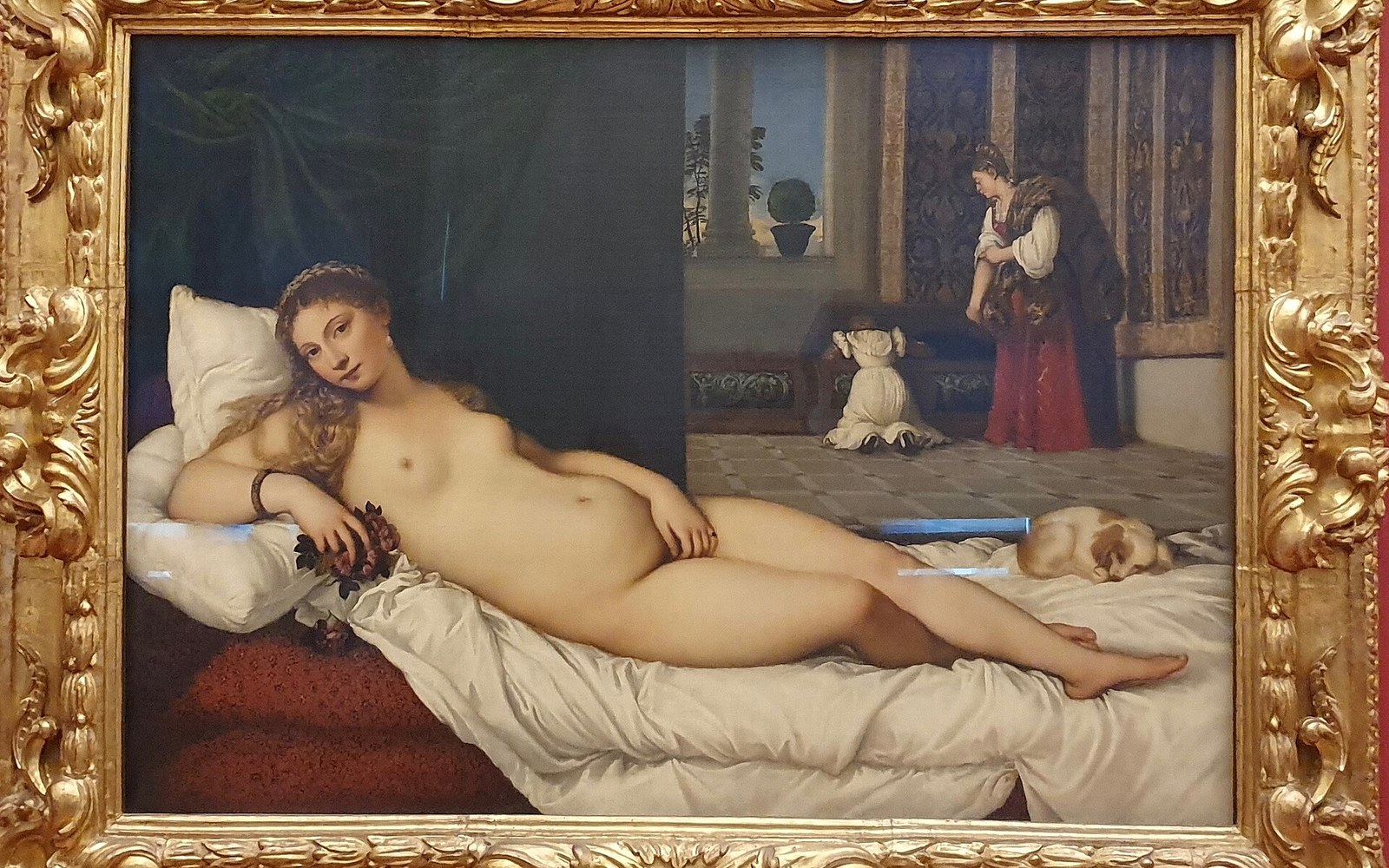
Titian, 1538. The cassone at the back of the room is the picture’s domestic argument. — What Titian's Venus Is Actually Looking At.
Photo: Venus of Urbino by Titian-Uffizi · Wikimedia CommonsA Fortnight of Reviews

Close enough that the paint stops describing a person.
Photo: Polina ⠀ / PexelsThe Salon of 1865 opened in May. The critical response to Olympia was, by contemporary accounts, unusually sustained and unusually personal. Reviewers coined terms: one described the figure as a gorille (gorilla), another as a Venus with a cat. The nakedness itself attracted less specific commentary than the combination of nakedness with directness of address. Academic nudes — the figures produced by successful candidates of the École des Beaux-Arts ↗ whose work filled the Salon — typically looked elsewhere: up into myth, down into sleep, sideways into narrative. Olympia looked back. That frontal engagement violated an implicit contract by which the depicted body remained an object of viewing rather than a participant in it.
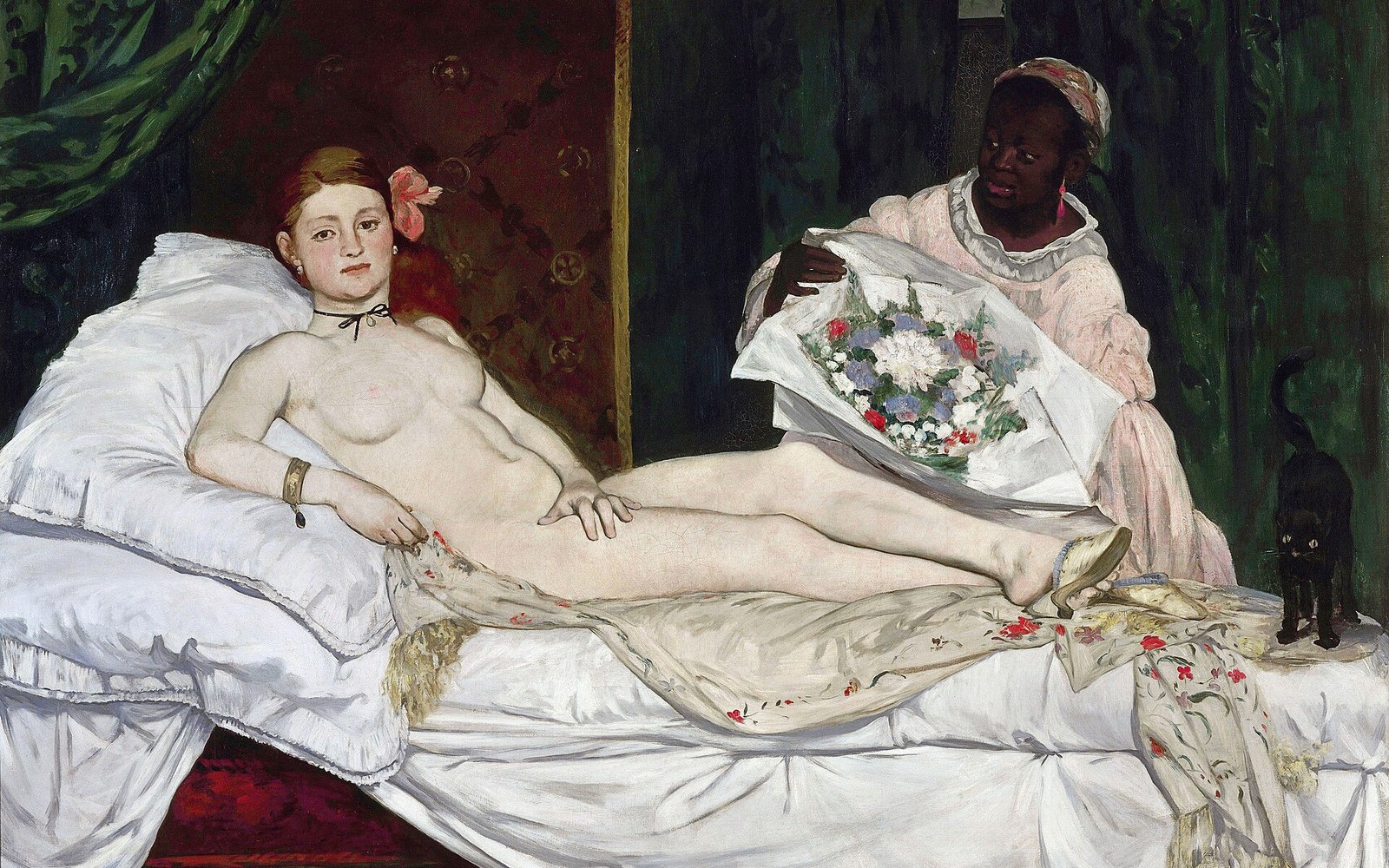
Olympia on the wall at the Musée d’Orsay, where the picture has hung since 1986.
Photo: Edouard Manet - Olympia - Google Art ProjectFXD · Wikimedia CommonsThe cat drew particular comment because it was plainly not the cat of allegory or genre — the charming domestic animal of Dutch interior painting — but a streetwise, sexually coded creature with its back up. The bouquet, too, came in for analysis: who sent it? The painting declines to say, and the deliberate withholding of that information was read, correctly, as part of the provocation. The work won considerable scholarly attention in the twentieth century as a text about the commodification of the female body, about the male gaze as a social institution, and about the painting's refusal to sentimentalize either.
Manet himself, then thirty-three, was reportedly shaken by the reception. He had not, by his own lights, submitted a scandal; he had submitted a painting with clear art-historical ambitions, technically accomplished and deliberately positioned within the tradition. What he had miscalculated — or perhaps calculated exactly — was how visible the tradition would become once it was restaged in contemporary clothes, on a daybed that looked like a daybed rather than a classical couch.
Manet himself, then thirty-three, was reportedly shaken by the reception.
Zacharie Astruc, Émile Zola, and After
And the cat — small, black, alert, obviously alive — continues to hold its end of the gaze.
Two of Manet's defenders were Zacharie Astruc, who had supplied the verse for the catalogue, and the young Émile Zola, who defended Manet in L'Événement in 1866 and in a fuller essay in 1867, arguing that Manet's flatness of paint and directness of composition represented an advance, not a failure. Zola's argument — that technical choices were aesthetic positions rather than incompetences — was influential on the generation of painters gathering around the Café Guerbois and would become a founding text for what became known as Impressionism. Manet himself never exhibited with the Impressionists, remaining committed to the Salon as the relevant arena.
Olympia was not sold during Manet's lifetime. After his death in 1883, a public subscription organized by Claude Monet in 1889 raised enough to purchase the painting and present it to the French state, bypassing the risk of it leaving France. It entered the Louvre's collection — a significant institutional endorsement — and was transferred to the Musée d'Orsay when that museum opened in 1986. It now hangs in the Musée d'Orsay's galleries alongside works by Courbet and several large Impressionist canvases, a curatorial grouping that makes the argument Zola later made visible in architectural form.
The painting has been reproduced, parodied, and restaged so many times that its original capacity to shock is genuinely difficult to recover. What remains immediately legible, standing in front of the canvas rather than a reproduction, is its scale and its directness of paint. The figure is not idealized: the body is observed, the light is Parisian studio light, the space is shallow and the colour range compressed. And the cat — small, black, alert, obviously alive — continues to hold its end of the gaze.