What Titian's Venus Is Actually Looking At
She is looking at you — and that is the whole argument.
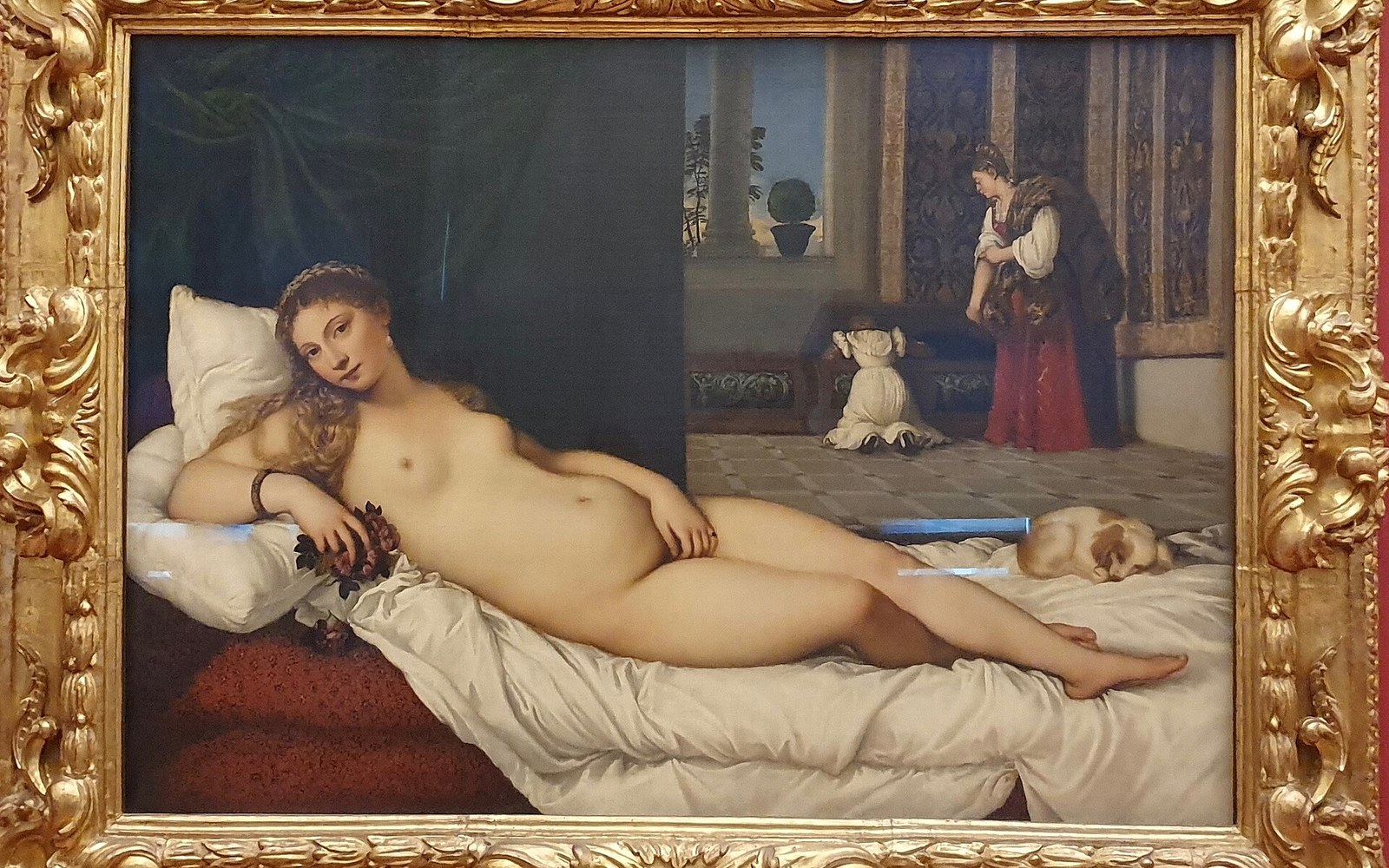
Titian, 1538. The cassone at the back of the room is the picture’s domestic argument.
Photo: Venus of Urbino by Titian-Uffizi · Wikimedia CommonsThe Architecture of the Gaze
The Venus of Urbino hangs in the Uffizi at roughly life scale, and the first thing it does is return your look. The figure reclines across a wide couch, turned slightly toward the picture plane, her left hand resting between her thighs. Nothing in the pose suggests sleep or reverie. The eyes are open, level, unhurried. She is not caught. She is waiting.
Titian completed the canvas in 1538 for Guidobaldo della Rovere, heir to the Duchy of Urbino, probably as a gift to himself rather than his new bride. The letter Guidobaldo sent chasing the delivery — calling the picture "the naked woman" — tells you everything about how the patron understood the commission. No goddess title appears in his correspondence; the subject is simply a beautiful woman, owned in the same register as the furniture she lies on.
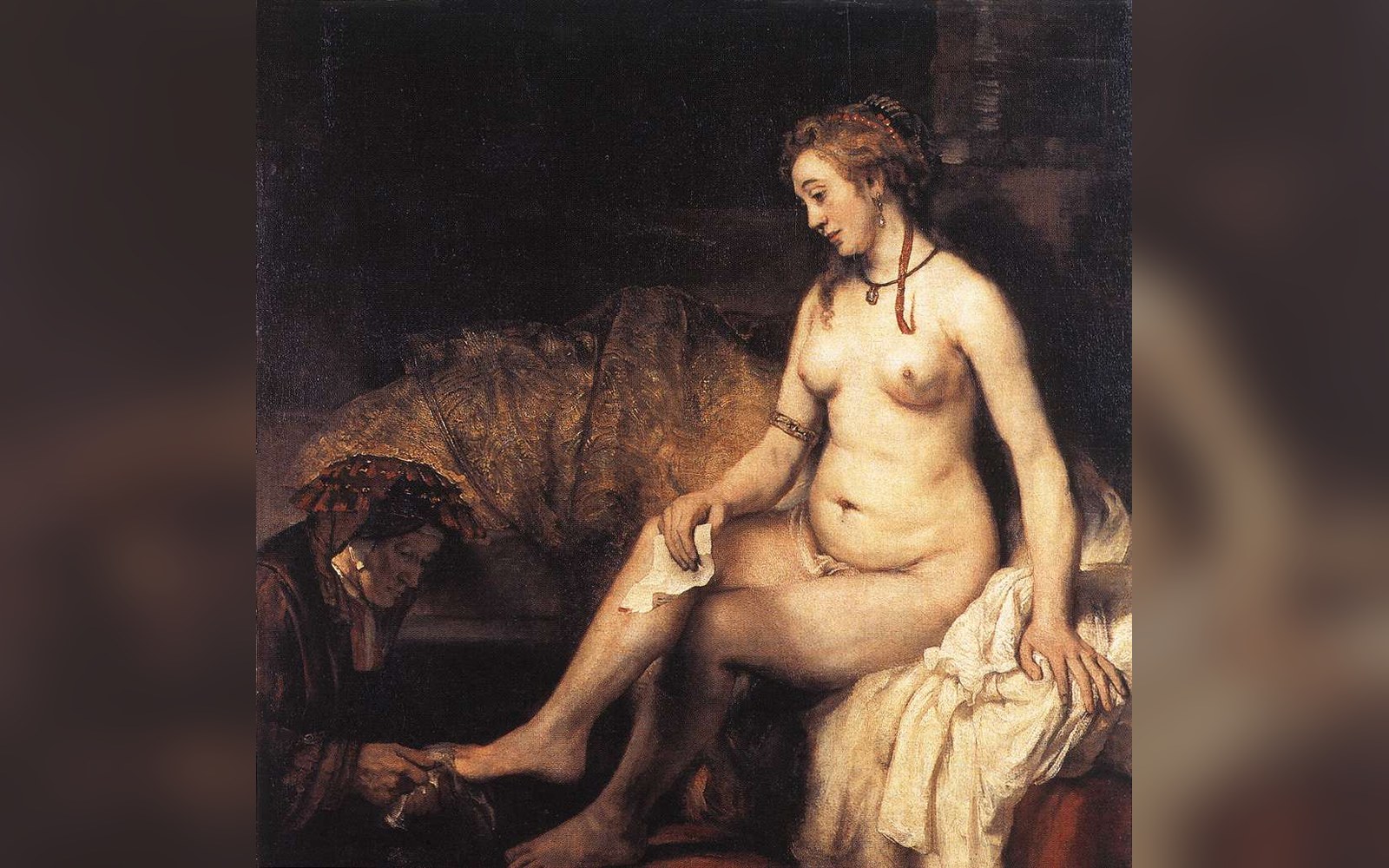
Rembrandt, 1654. The letter in her hand is what the pose is thinking about. — Rembrandt Gave Bathsheba a Real Letter.
Photo: Rembrandt - Bathsheba at Her Bath - WGA19090 · Wikimedia CommonsThe dog curled at her feet is doing what dogs do: sleeping, indifferent, warm. Critics have loaded it with symbolism — fidelity, domesticity — but its primary compositional function is to anchor the lower right of the picture and make the figure's alertness more striking by contrast. Everything at the bottom sleeps; everything at the top watches.

Close enough that the paint stops describing a person.
Photo: Polina ⠀ / PexelsBehind the figure, pushed into the middle ground by a dark curtain that bisects the room, two servants rummage in a cassone, a marriage chest. One kneels, one bends. Their activity is mundane and absorbed, scaled back so they barely register against the depth of the room. A window opens onto a landscape. Light falls from the left. The spatial logic is precise: the servants occupy the world of ordinary time while the figure in the foreground inhabits something else — a continuous, pressured present.
The dog curled at her feet is doing what dogs do: sleeping, indifferent, warm.
What the figure is looking at is whoever commissioned the canvas, and by extension whoever stands in front of it now. Édouard Manet understood this exactly when he positioned Victorine Meurent in the same reclining format for his 1865 Olympia, lifting the gaze wholesale. The scandal Manet caused was in part because the Venus of Urbino's implicit transaction had been running politely for three centuries, and Manet made it explicit ↗.
Titian's Venus is not a goddess because she acts like one. She is a Venus because the title permits a certain distance between the image and what it actually is — a painting made for a man's private rooms, of a woman who looks back at him with complete composure and no apparent concern about what he sees. The gaze is not seductive. It is declarative. The picture knows what it is.