Ingres Gave Her Three Extra Vertebrae and Was Unapologetic
The Grande Odalisque (1814, Louvre) stretches the human spine past any anatomical limit — and the painting is more powerful for it.
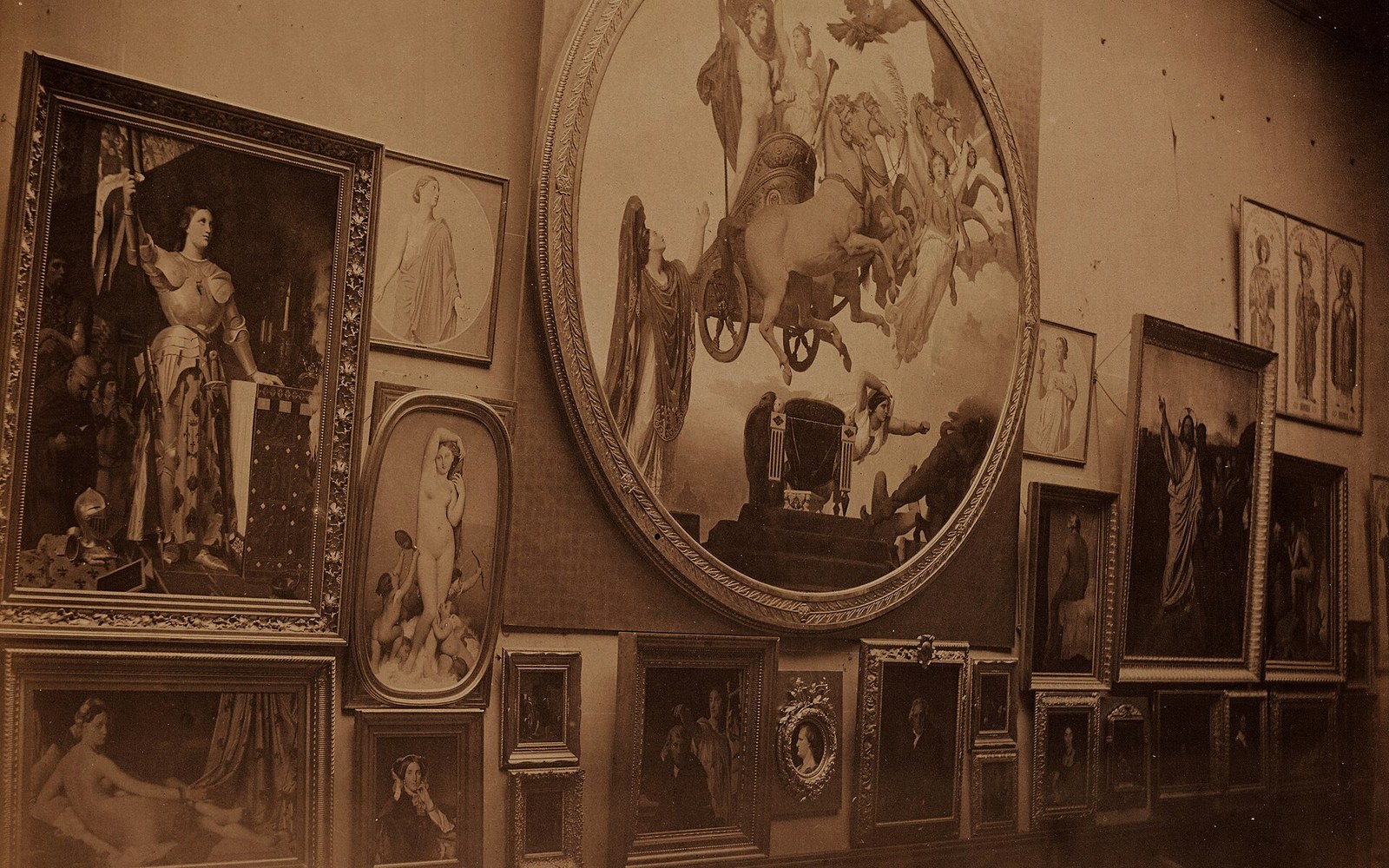
Ingres in the Beaux-Arts galleries, where his odalisque hung among the prize pictures the concours produced.
Photo: Expo 1855 Disdéri galerie française Ingres f18 · Wikimedia CommonsThe Charge
When the Grande Odalisque ↗ appeared at the Salon of 1819, it had been sitting in Ingres's studio for five years, finished but unshown. Critics noticed the back immediately. The French anatomist and art critic Étienne-Jean Delécluze counted three vertebrae too many — a spine that no living woman's body could accommodate. The accusation was stated as a fault, even a professional embarrassment for a painter who had trained rigorously at the École des Beaux-Arts under Jacques-Louis David and had won the Prix de Rome in 1801.
Ingres did not revise. He did not apologize. Everything in his refusal to revise, and in the decades of work that followed, suggests he regarded the elongation as a necessity, not an error — a decision about what the figure needed to be, rather than a failure to observe what a figure actually was.
That position is worth taking seriously, because the painting demands it.
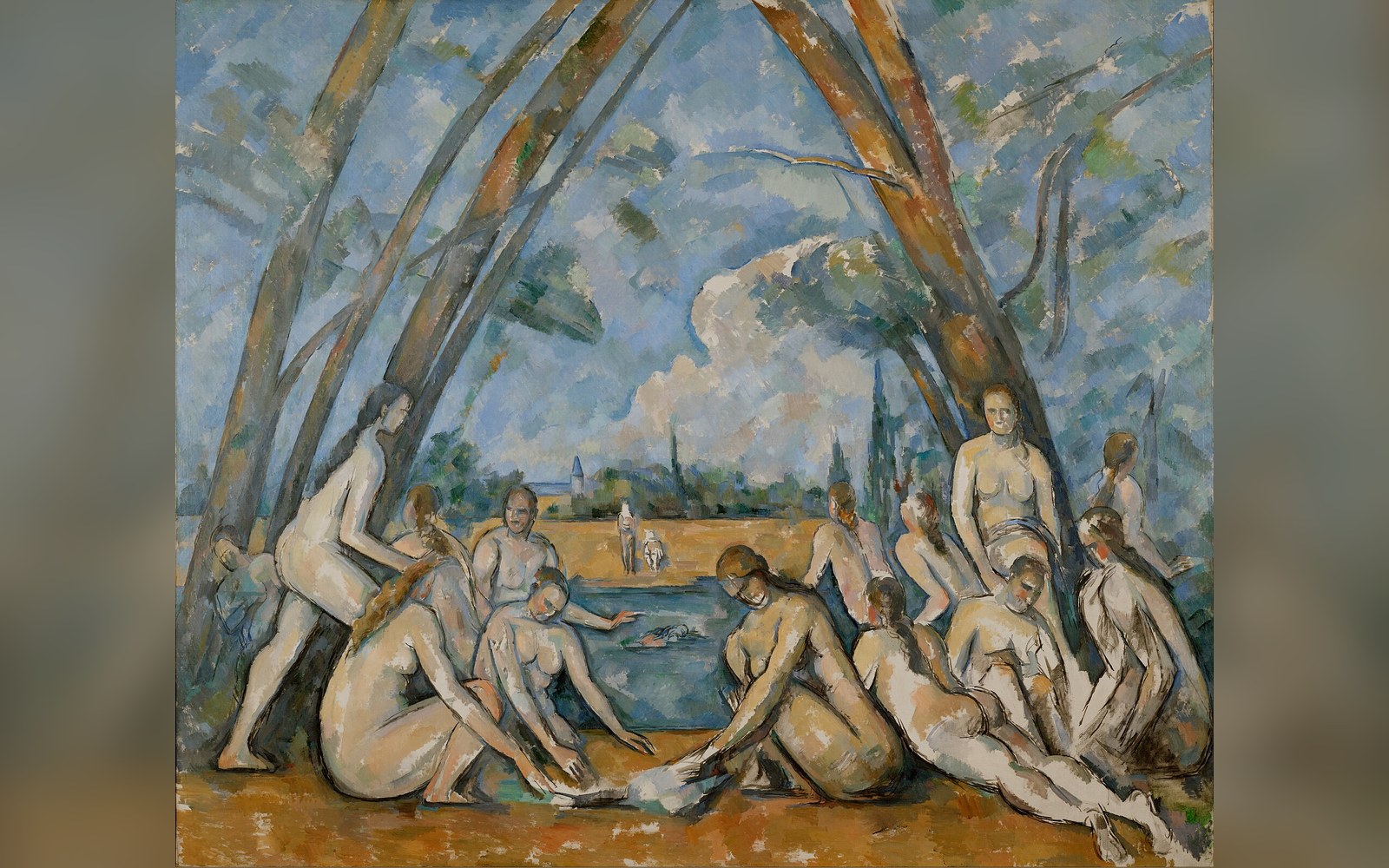
Philadelphia’s version: figures assembled from drawings, set out with the logic of an elevation rather than a life class. — Cézanne Painted Bathers for Thirty Years Without a Model in the Room.
Photo: Paul Cézanne, French - The Large Bathers - Google Art Project · Wikimedia CommonsWhat the Distortion Does
Close enough that the paint stops describing a person.
Photo: Polina ⠀ / PexelsThe figure lies away from the viewer, turning her head back over one shoulder, her gaze arriving at you from across a gulf of cool, continuous back. That back is the painting. Without the added length, the distance between the tilted head and the raised knee collapses into something merely plausible; the body becomes a body in a room rather than a surface that fills — and exceeds — the frame. The three extra vertebrae are not anatomical carelessness but compositional argument: they buy the lateral expanse that keeps the eye moving and the figure just beyond reach.
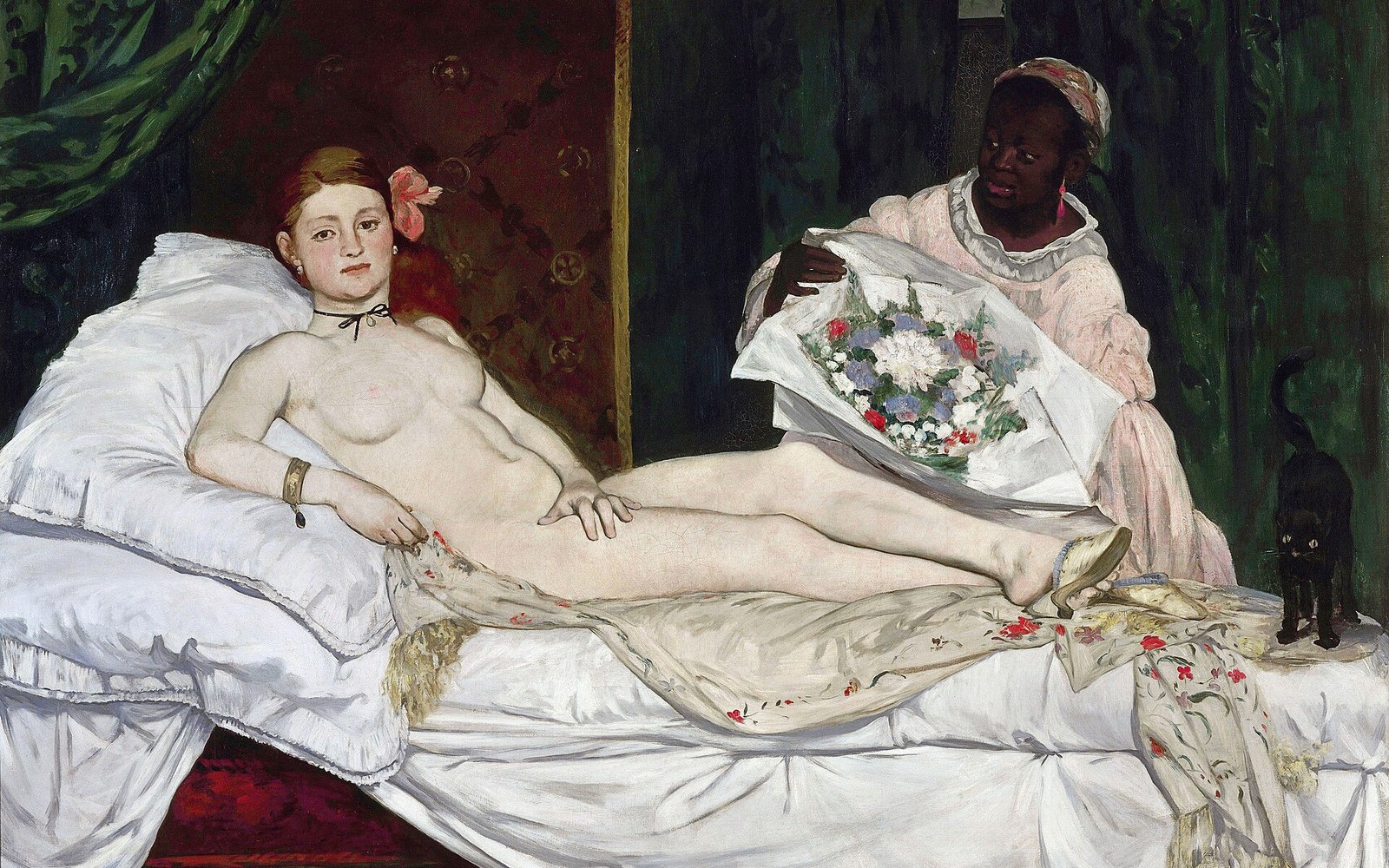
Olympia on the wall at the Musée d’Orsay, where the picture has hung since 1986.
Photo: Edouard Manet - Olympia - Google Art ProjectFXD · Wikimedia CommonsIngres had spent his formation years drawing académies in the disciplined French tradition — the constrained pose, the charcoal line, the insistence on structural truth. He knew exactly where the sacrum sits. The elongation in the Odalisque is not ignorance; it is the same kind of deliberate formal decision that Mannerist painters of the sixteenth century had made with elongated necks and tapered fingers — a modification of the body in the direction of an ideal that no real body provides. Pontormo, Parmigianino, Bronzino: Ingres had studied them in Italy, and the lineage shows.
That position is worth taking seriously, because the painting demands it.
What sets the Grande Odalisque apart from those predecessors is the coolness of its surface. The skin is almost without texture — poreless, shadowless in the tradition of Raphael, whom Ingres regarded as the highest standard. The foot, the peacock-feather fan, the fabric heaped around the hips are rendered with meticulous particularity, making the smoothed, impossible back read not as vagueness but as a different order of attention. The anatomical distortion and the hyperrealist detail coexist in the same canvas, and the tension between them is precisely what makes the picture uncomfortable to stand in front of.
The anatomical distortion and the hyperrealist detail coexist in the same canvas, and the tension between them is precisely what makes the picture uncomfortable to stand in front of.
The setting — the undulating feathers, the hookah pipe, the hanging curtain, the turban — places the figure inside the Orientalist fantasy that preoccupied French painting throughout the nineteenth century. Ingres had never been to the Ottoman empire. He was constructing an imaginary interior, and the body he placed in it was equally constructed: longer, more continuous, more remote than any actual model could be. The fantasy and the distortion are the same move.
By 1819 the neoclassical moment that David had commanded was giving way to Romantic energy — Géricault would show The Raft of the Medusa at the same Salon — and the critics who attacked Ingres were in some ways attacking the whole premise of a painting that put formal perfection above expression. Ingres went on making that argument for another four decades. The Turkish Bath, finished in 1862 when he was eighty-one, is still full of boneless, endlessly smooth figures that could not be built from any skeleton.
The Grande Odalisque did not survive the Salon well. It sold slowly, passed through several collections, and entered the Louvre in 1899. The back is still wrong. It remains, on balance, right.