Cézanne Painted Bathers for Thirty Years Without a Model in the Room
By the mid-1870s Paul Cézanne had largely stopped painting from the nude. He was a deeply inhibited man working in provincial Aix-en-Provence, where the conventions of bourgeois life — and his own acute awkwardness around women — made hiring a female model essentially impossible for him. He had painted clothed figures and male bathers with some directness in the 1860s and early 1870s, but as the monumental figure compositions he envisioned grew more ambitious, the practical means of realising them grew further from reach. His solution was peculiar in the history of painting and arguably unique in its consequences: he would construct the nude from memory, from imagination, and above all from the académies he had made as a young man in Paris.
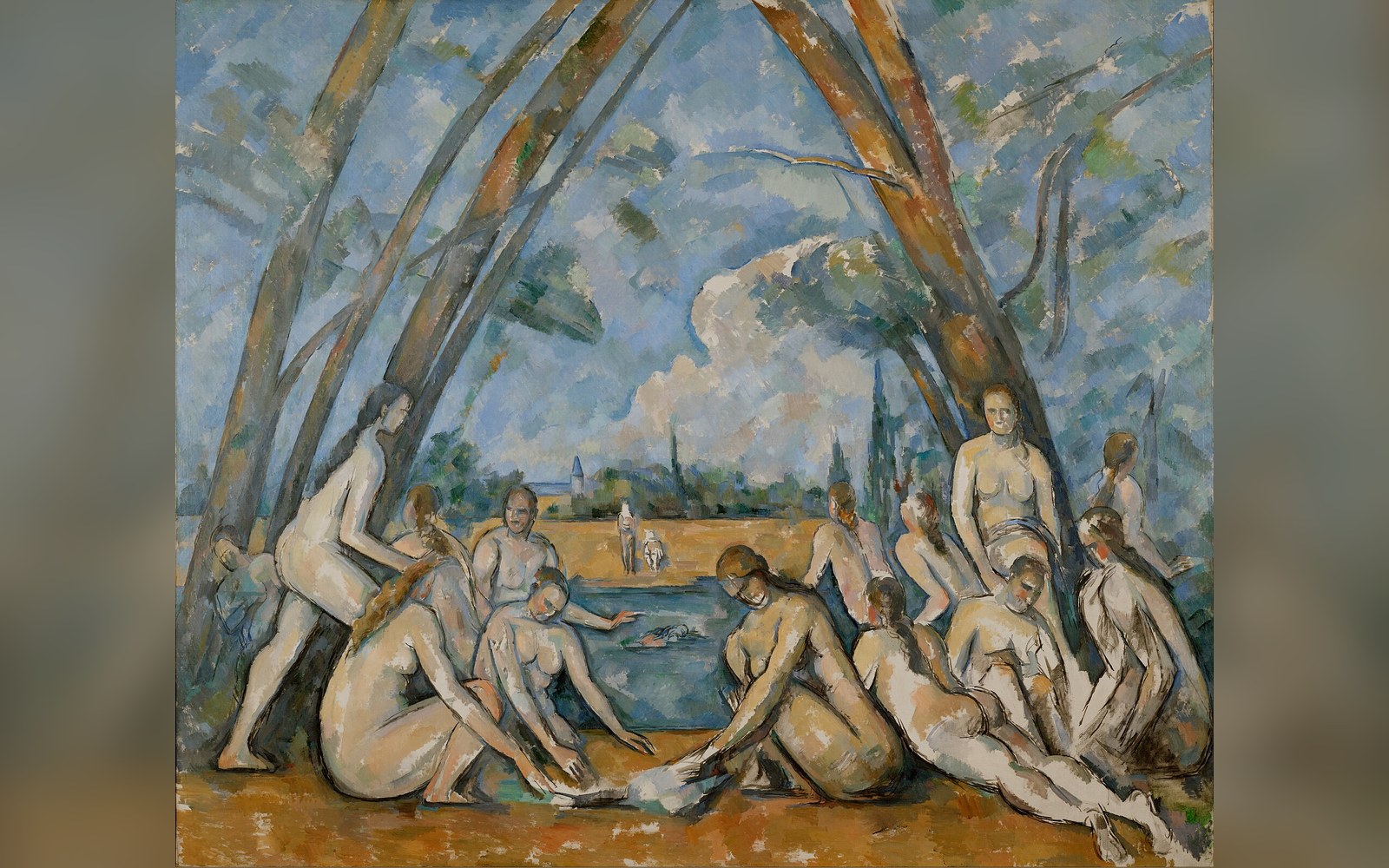
Philadelphia’s version: figures assembled from drawings, set out with the logic of an elevation rather than a life class.
Photo: Paul Cézanne, French - The Large Bathers - Google Art Project · Wikimedia CommonsThe problem he could not solve from life
The word académie — a formal drawing of an adult nude model in a set pose, executed as a studio exercise — names exactly the residue Cézanne was drawing on. He had attended drawing sessions at the Académie Suisse in Paris in the early 1860s, an open studio that charged modest fees and supplied models without instruction. What he produced there was, by his own later judgment, inadequate. But those drawings and the habits of looking they formed became the primary source material for figures he would rework obsessively for the remaining decades of his life. He also copied from plaster casts, from prints, and from reproductions of works by Rubens, Michelangelo, and Puget. Titian's Concert Champêtre in the Louvre, glimpsed across the tradition of the reclining and bathing nude, hovered behind the project even if Cézanne's bathers share almost nothing of Titian's ease.
What the three large canvases are, and where they are
The Bathers series in its larger versions breaks into three paintings, each known by its holding institution. The earliest of the three large versions belongs to the Barnes Foundation, Philadelphia; it dates to roughly 1895–1906. The second large version is held by the National Gallery, London, and is generally dated to 1894–1905 as well, a dating that reflects the difficulty of placing Cézanne's undated, slowly accrued canvases with any precision. The third and largest — the one that has drawn the most sustained critical attention since Roger Fry first identified it as a summation — hangs in the Philadelphia Museum of Art ↗, which acquired it in 1937 through the W. P. Wilstach Fund. The Philadelphia canvas measures approximately 208 by 249 centimetres. It is the biggest figure painting Cézanne made.
The three differ in measurable ways beyond scale. The Barnes version is warmer in key, the foliage more closed, the figures slightly less fractured in their relation to each other. The National Gallery version shares the arched-tree canopy structure but the handling in the sky and the weight of the figures differ from Philadelphia's. In the Philadelphia canvas the arch of trees closes almost architecturally over the bathers, pressing them into a frieze-like compression. The figures — eleven women, roughly disposed in two flanking groups with an opening at the centre — are barely particularised. Their faces are suppressed, their poses echo classical sculpture and Renaissance painting at a generality that makes individual identification impossible and probably beside the point.
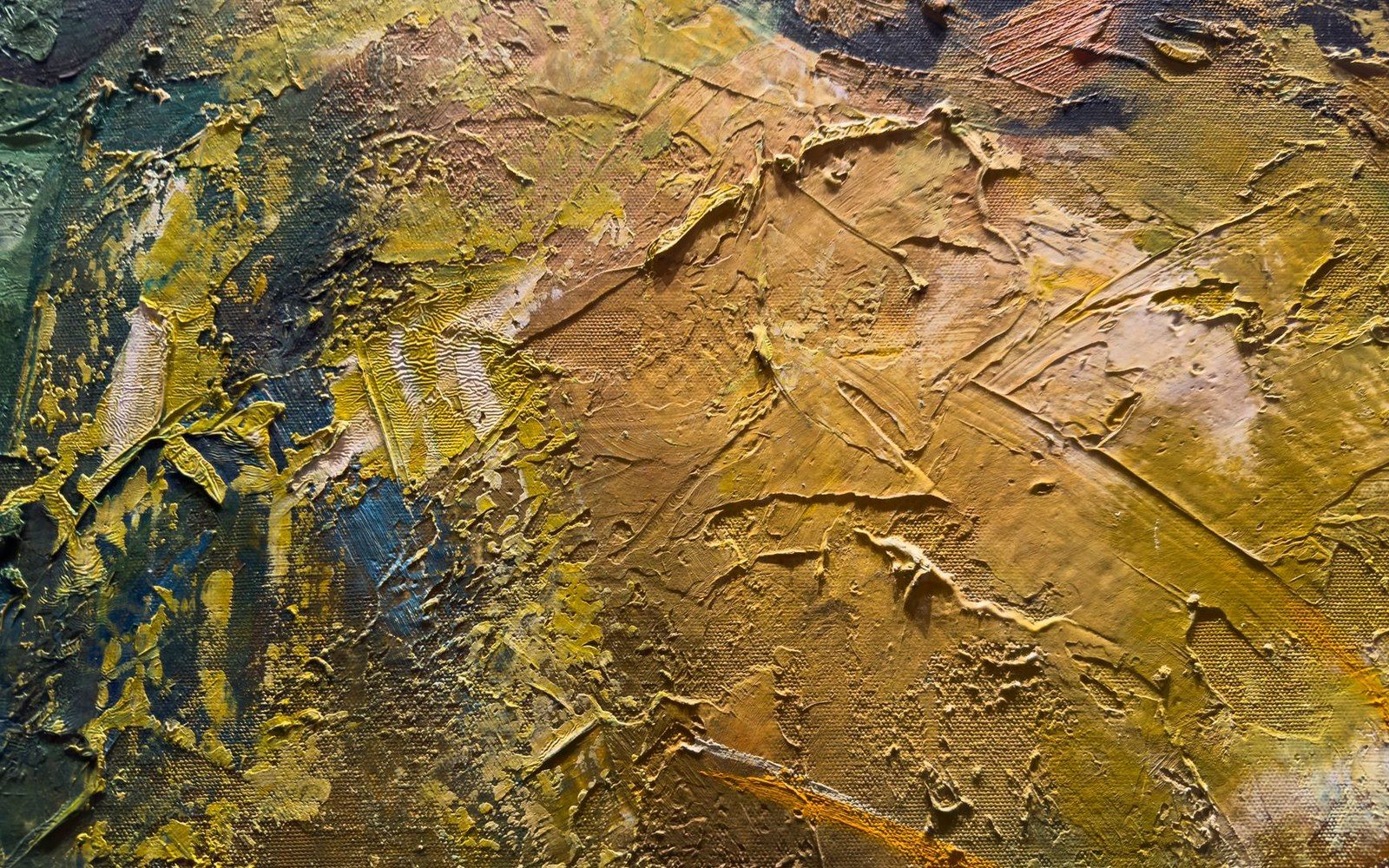
Impasto loaded heavily enough that gallery light, not tone, does the modelling. — Freud, Nine Months of Four-Hour Sittings.
Photo: Engin Akyurt / PexelsThirty years of not finishing
Close enough that the paint stops describing a person.
Photo: Polina ⠀ / PexelsCézanne left the Philadelphia canvas in his studio when he died in October 1906. He had not declared it complete, and the evidence of the surface — areas of bare canvas still visible, passages where the paint thins to near-transparency — suggests it was, by any conventional standard, unfinished. Whether Cézanne regarded the category of completion as applicable to the canvas is another matter. He had written, in correspondence, about the difficulty of realising his sensation — the felt encounter between eye and motif — on a painted surface, and the bathers series represents a case where the motif existed nowhere outside the mind. There was no landscape to sit in front of, no assembled group of nude women to look at. He was constructing sensation from its absence.
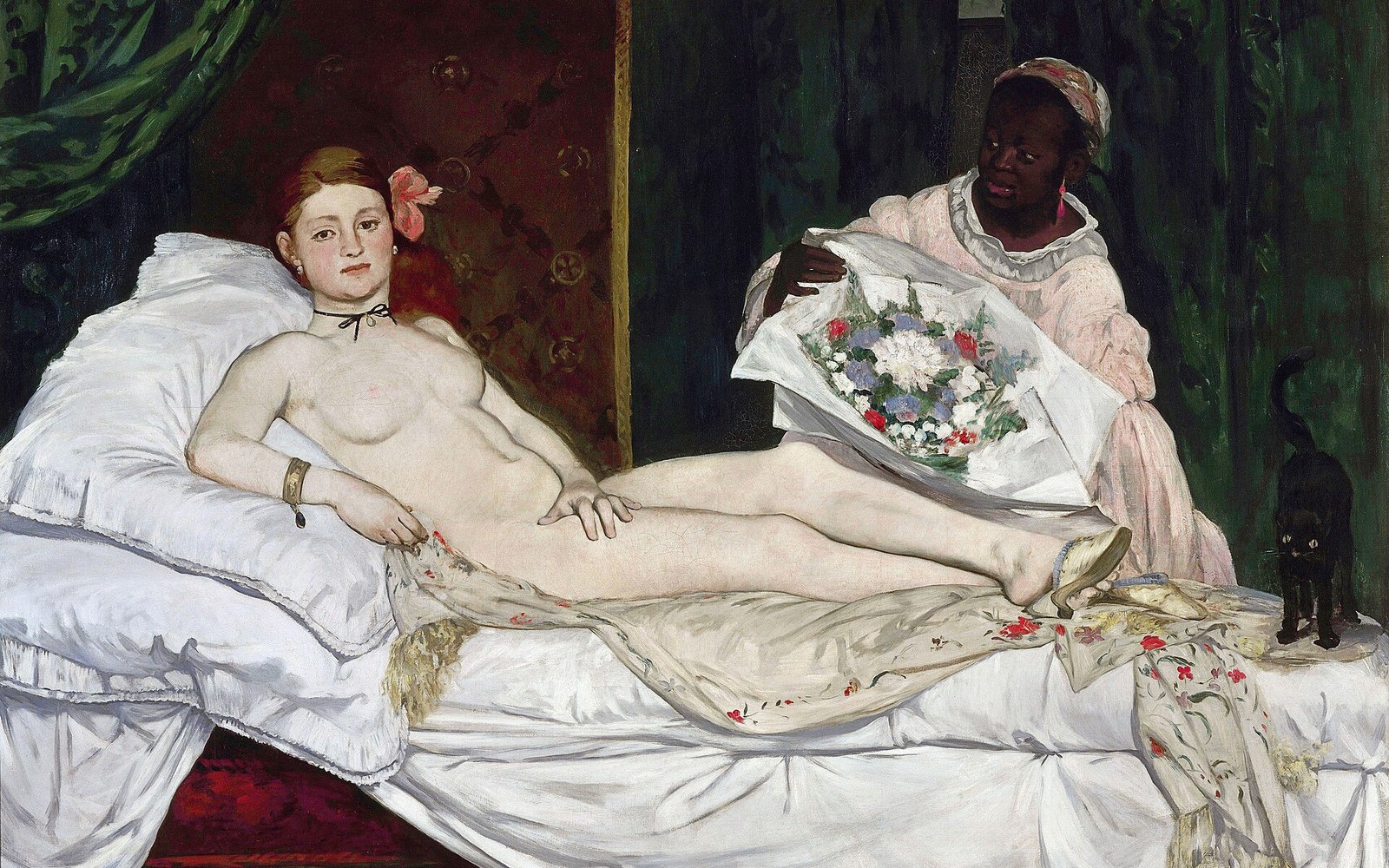
Olympia on the wall at the Musée d’Orsay, where the picture has hung since 1986.
Photo: Edouard Manet - Olympia - Google Art ProjectFXD · Wikimedia CommonsThe poses in the Philadelphia Large Bathers descend at a remove from the académies of his youth, which themselves descended from a tradition running through the École des Beaux-Arts and the Prix de Rome — a tradition Cézanne had never formally entered. He was turned down by the École. His relationship to the academic system was that of an outsider who had absorbed its drawings and its muscular canon of the body without having earned entry to the rooms where that canon was transmitted. The bathers, seen this way, are the record of a self-education in the nude that proceeded almost entirely through secondary materials and memory.
They feel like a search for a coherent pictorial architecture in which the figure and the ground are built from the same materials.
What makes the result strange, and what distinguished it immediately for the painters who came after, is how thoroughly Cézanne's distortions serve structural rather than expressive ends. The elongated upper limbs in the Philadelphia canvas, the compressed and slightly inhuman heads, the passages where a figure's edge bleeds into the landscape behind it — none of these feel like mannerism or wilful deformation. They feel like a search for a coherent pictorial architecture in which the figure and the ground are built from the same materials. Matisse, who acquired the small Three Bathers (now in the Petit Palais) earlier in his career and kept it for decades, identified in it a lesson about the relation of the painted body to the painted space around it that he found nowhere else. Picasso, whose absorption of the bathers contributed to the tilted spatial logic of the figures in Les Demoiselles d'Avignon, took a different lesson — flatter, more violent, more fracturing — from the same source.
What the surface shows
Up close, the Philadelphia canvas reveals Cézanne's method in unusually bare form. Thin, directional strokes of blue and green build the foliage in overlapping planes; the same strokes, migrating in colour toward ochre and flesh, constitute the bodies. There is no sharp division between what counts as landscape and what counts as figure. The ground beneath the bathers is worked with as much attention as the figures themselves, and the sky, pressed into a narrow band at the top, carries the same constructive energy as everything below it. Paint application in the figures varies from thin washes to modest impasto, though never the emphatic impasto of van Gogh or the late Monet. Cézanne's surface is tentative in places, decisive in others, and the combination reads less as incompletion than as an honesty about how difficult the realisation was. He was painting from a version of the figure he held entirely in his head, without the corrective pressure of a model in the room, and the result is one of the few large-format figure paintings in Western art that feels like it cost its maker everything he knew how to give.