The Picture That Broke the Room It Was Shown In
Picasso's Les Demoiselles d'Avignon sat rolled in his studio for nearly a decade. The handful of people who saw it first did not know what to say — and several said something terrible.
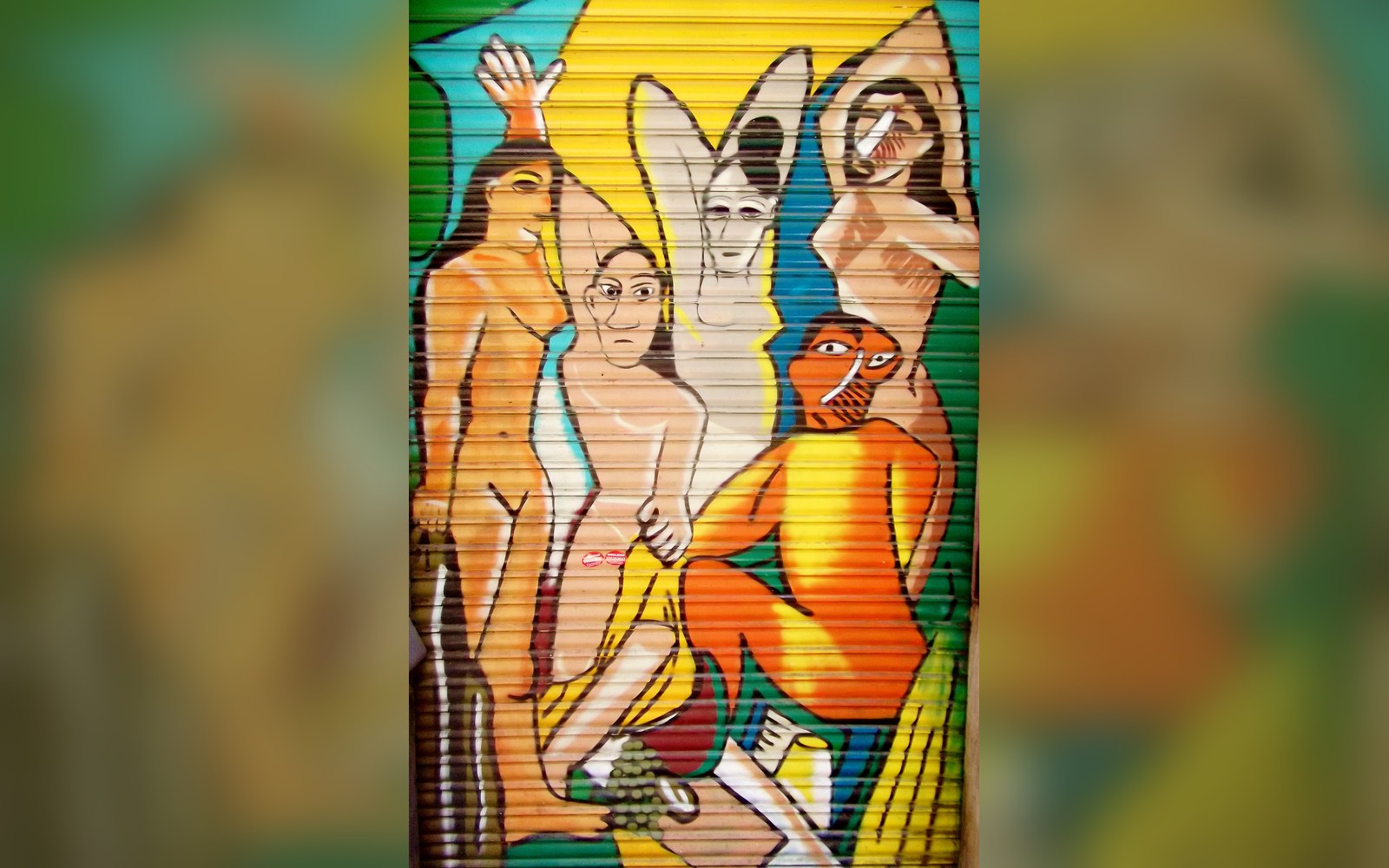
The canvas Braque, Matisse and Derain saw in the studio in 1907, nine years before it was shown in public.
Photo: Les Demoiselles d'Avignon · Wikimedia CommonsWhat the First Viewers Encountered
The canvas arrived in the spring of 1907 in Picasso's studio at the Bateau-Lavoir in Montmartre, nearly two and a half metres tall, its five figures arranged across a field of angular planes that seemed to attack each other rather than compose. Braque, who saw it that year, reportedly said it felt as if Picasso were making him eat rope or drink petrol — a visceral rejection rather than a critical one. Matisse read it as mockery. Derain confided his belief that Picasso would one day be found hanged behind the large canvas. These are not polished critical assessments; they are evidence of a specific kind of shock — the shock of a painting that had used the inherited conventions of the standing nude and done something to them that looked less like development than like rupture.
The figure tradition Picasso inherited ran from Titian through Ingres: the female body as a harmonized surface, presented to the viewer in a stable spatial field. The five women in the Demoiselles occupy no such field. The three left-hand figures are angular and dissonant but still connected, however roughly, to an Iberian influence Picasso had been absorbing since at least 1906. The two figures on the right are different in kind. Their faces are fractured, mask-like, with eyes displaced and features rendered as competing planes. These are the passages that made the canvas not simply radical but genuinely difficult to place within any lineage.
The Masks and What They Broke
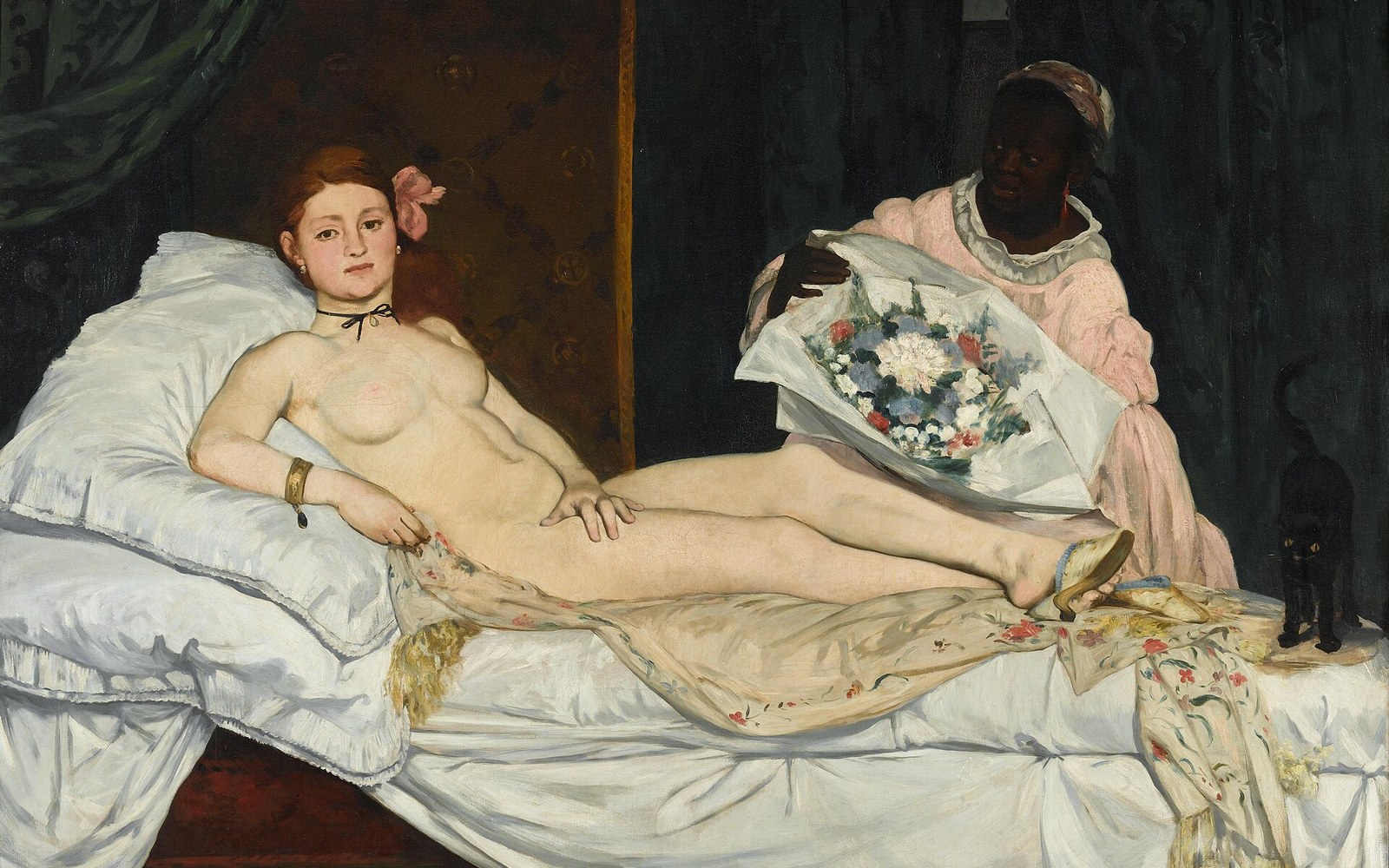
The canvas as the Salon crowd of 1865 met it: 130.5 by 190 centimetres of Parisian studio light, a retained slipper, and a cat holding its end of the gaze. — Olympia, and the Fortnight Paris Spent Shouting at a Cat.
Photo: Edouard Manet - Olympia - Google Art Project 3 · Wikimedia CommonsPicasso had visited the Trocadéro's ethnographic collection in Paris in 1907, an experience he later described — in remarks recorded by André Malraux decades after the fact — as transformative. The African and Oceanic objects he handled there were not, for him, exotic curiosities; they operated, he suggested, as tools against something, as objects made to mediate between people and hostile forces. Whether or not that account is retrospectively tidied, what it describes is a functional relationship to imagery rather than an aesthetic one. The Trocadéro material now forms part of the Musée du quai Branly–Jacques Chirac collection ↗, though what Picasso handled in 1907 no longer exists in exactly the configuration he encountered.
Close enough that the paint stops describing a person.
Photo: Polina ⠀ / PexelsThe consequence for the figure is specific. Academic tradition — the tradition running through the Académie Royale and its académie drawings — treated the surface of the body as something to be understood through unified light, coherent anatomy, and a fixed viewpoint. What the right-hand figures of the Demoiselles do is refuse that fixed viewpoint. A face can be simultaneously frontal and in profile. A body can be shown from multiple vantages without that contradiction being resolved. This was not Cubism yet — the Demoiselles predates the systematic development Braque and Picasso pursued together after 1908 — but it was the opening cut.
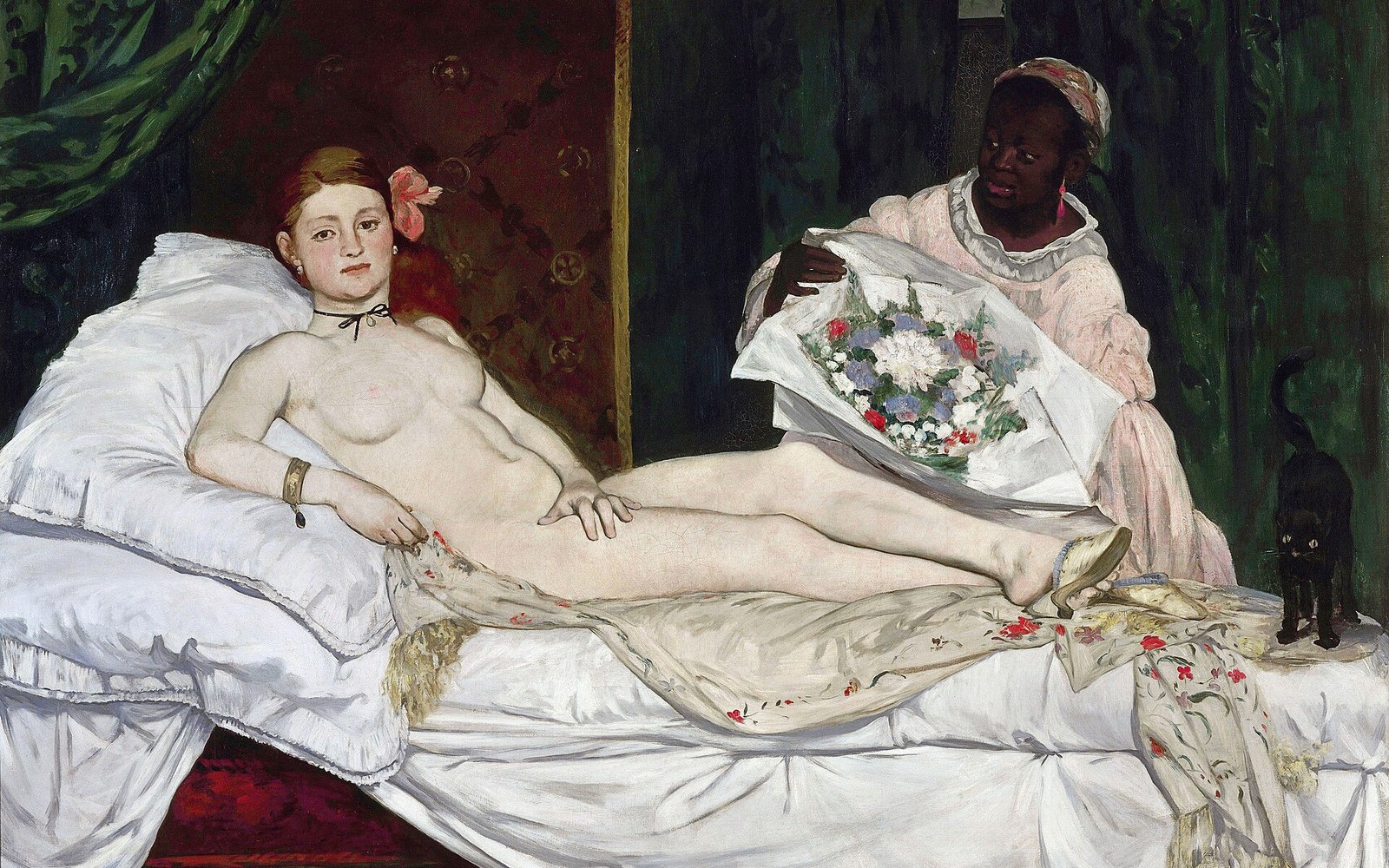
Olympia on the wall at the Musée d’Orsay, where the picture has hung since 1986.
Photo: Edouard Manet - Olympia - Google Art ProjectFXD · Wikimedia CommonsNine Years in the Studio
The painting was not publicly exhibited until 1916, when it appeared at the Salon d'Antin in Paris. Before that, it was known to a small circle — dealers, painters, collectors — who responded to it privately and inconsistently. MoMA acquired it in 1939 ↗, and the museum's published record gives the dimensions as approximately 243.9 × 233.7 cm, oil on canvas. The long delay before exhibition is itself part of the painting's meaning: Picasso kept it because he had not finished thinking about it, or because he knew what showing it would cost him among people whose opinion still mattered to him, or both.
What the Demoiselles did to the figure tradition is not simply that it broke it. Traditions absorb breaks. What it did was make the break visible as a method — made the discontinuity itself the subject. Every subsequent painter who stood a figure in front of a canvas and decided not to resolve it owed something to that room in the Bateau-Lavoir, and to the people who walked out of it not knowing how to describe what they'd seen.