Kerry James Marshall Made the Figure Black Because the Tradition Had Not
A painter who read the archive and answered it on canvas — systematically, across decades.
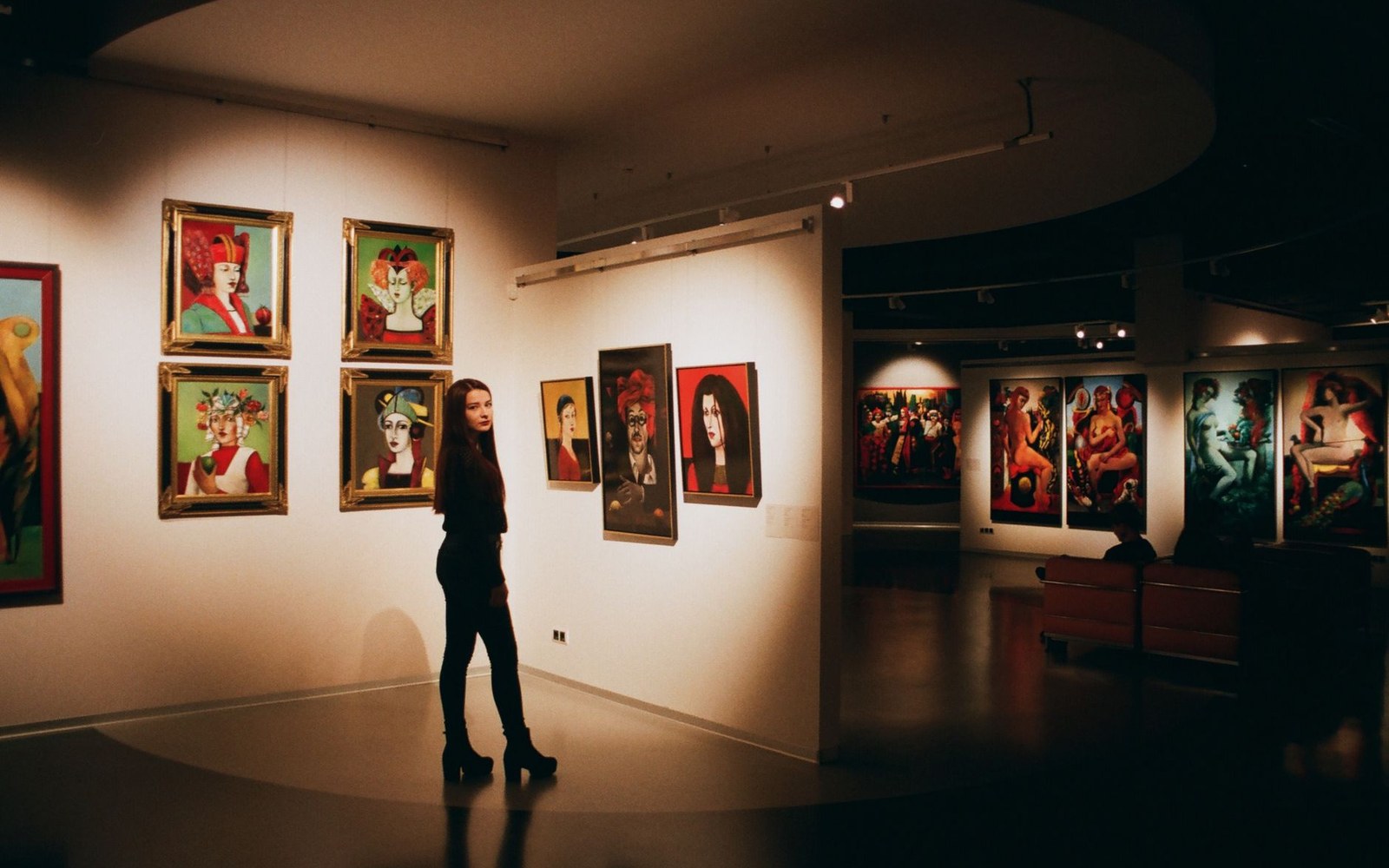
Contemporary hanging: the tradition’s unstated default is what Marshall’s canvases are arguing with.
Photo: Darya Sannikova / PexelsThe Argument Stated
Western figure painting carries a default setting that mostly goes unannounced. From the Venus of Urbino to the Grande Odalisque, from the academic nude to the Impressionist bather, the body that appears without explanation — without the burden of representing a category — is assumed to be white. Kerry James Marshall has spent his career pointing this out, not in print but in paint, and the result is one of the most coherent bodies of figure work produced by any painter in the last forty years.
Marshall trained at the Otis College of Art and Design in Los Angeles in the 1970s, where he came up against the canon in its full weight — the European masters, the life class, the problem of pictorial space and figure-ground. He absorbed all of it deliberately. The work he then made is not a rejection of the tradition but an occupation of it: technically accomplished, compositionally literate, and calibrated to expose what the tradition had omitted by treating the omission as a formal problem.
What the Paintings Do
The figures in Marshall's canvases are Black, and their blackness is not a skin tone among skin tones — it is pushed toward an unmodulated, almost formal darkness, faces and bodies built from deep pigment that refuses the flesh-tone conventions academic painters spent centuries codifying. This is a considered choice. The Munsell-adjacent project of matching value and chroma to observed skin never enters the equation; instead, Marshall constructs a visual argument about representation itself. If the Western tradition treated white skin as neutral — requiring no comment — then he will treat very dark skin with the same non-apology. The result is figures who simply exist in their pictorial world without being explained to the viewer.

The apartment studio, the easel, and a sitter who has agreed to be seen accurately. — Alice Neel Painted People Who Did Not Come Out Looking Good.
Photo: Anastasia Shuraeva / PexelsSouvenir I (1997, Art Institute of Chicago) places a Black couple in a domestic interior crowded with commemorative imagery — pennants, portraits, the signifiers of community memory — while the couple themselves sit still and specific. The painting is gorgeous in a way that is not accidental: Marshall uses beauty as a rhetorical instrument, borrowing the compositional assurance of the old masters while putting entirely different bodies in their place.

North light, a loaded palette, a model on the stand: the working arrangement the academies formalised and the studios kept.
Photo: Vitaly Gariev / PexelsThe 2016 retrospective Mastry, which opened at the Museum of Contemporary Art Chicago before traveling to the Met Breuer in New York and the Museum of Contemporary Art Los Angeles, organized decades of this argument into a single, sustained statement. The title's variant spelling — "mastry" rather than "mastery" — folds the painter's name into the claim: this is what mastery looks like now, and now it looks like this.
Close enough that the paint stops describing a person.
Photo: Polina ⠀ / PexelsAmong the works shown was School of Beauty, School of Culture (2012, Birmingham Museum of Art, Alabama), a large-format canvas of a hair salon in which the figures inhabit a space dense with vernacular imagery — a beauty-supply poster, a salon mirror, the ordinary furnishings of a community interior. The painting's scale and its impasto confidence make it read with the seriousness of a history painting: this is a genre picture, a scene of contemporary life, a Vermeer-adjacent domestic interior — except the domestic life is one that had not previously been granted that kind of serious pictorial attention.
The title's variant spelling — "mastry" rather than "mastery" — folds the painter's name into the claim: this is what mastery looks like now, and now it looks like this.
Untitled (Underpainting) (2018, David Zwirner) pushes the formal argument further, placing black silhouettes against an underpainting left visible, as though catching the figures in the moment before they are resolved. It is a painting about painting — about what happens when the marks that usually stay hidden are allowed to remain.
Why It Matters to Figure Painters Now
Marshall's project is not polemic dressed as painting; it is painting that holds a polemic answerable to aesthetic standards. Technically, the handling of deep-value figures in middle-ground light — avoiding both the flattening that dark pigment can cause and the compensatory theatricality some painters reach for — is a genuine formal achievement ↗. The figures exist in space. They have weight. They carry none of the explanatory apparatus that might signal they are making a point; they simply occupy the canvas as figures in Western painting have always occupied it, except that for most of that history, they did not look like this.